Guidelines for submitting articles to Roda Golf Resort Today
Hello, and thank you for choosing La Torre Today.com to publicise your organisation’s info or event.
Roda Golf Resort Today is a website set up by Murcia Today specifically for residents of the urbanisation in Southwest Murcia, providing news and information on what’s happening in the local area, which is the largest English-speaking expat area in the Region of Murcia.
When submitting text to be included on Roda Golf Resort Today, please abide by the following guidelines so we can upload your article as swiftly as possible:
Send an email to editor@spaintodayonline.com or contact@murciatoday.com
Attach the information in a Word Document or Google Doc
Include all relevant points, including:
Who is the organisation running the event?
Where is it happening?
When?
How much does it cost?
Is it necessary to book beforehand, or can people just show up on the day?
…but try not to exceed 300 words
Also attach a photo to illustrate your article, no more than 100kb
PROPERTY SEARCH
PROPERTY SEARCH
article_detail
Date Published: 19/06/2026
Summer begins in Spain with the 2026 solstice this weekend
A brand new season will begin this Sunday June 21 with the longest day of the year
Summer is almost here and right now Spain is gearing up for the longest day of the year. The 2026 summer solstice will take place on Sunday June 21 at 9.24am Spanish Peninsular Time, according to calculations by the National Astronomical Observatory.
This marks the official start of summer in the Northern Hemisphere and it is the day with the greatest number of hours of sunlight.
During the solstice, the Earth reaches the point in its orbit where the Northern Hemisphere is tilted most toward the Sun. Because of this, the sun’s rays hit the Earth more directly and for a longer stretch, especially across the mid and high latitudes. In some Spanish cities, that means more than 15 hours of daylight. From this point on, the days will gradually shorten until the autumn equinox.
This year, astronomical summer will last approximately 93 days, running until Tuesday September 22, 2026.
In Spain and other parts of Europe, this moment is traditionally celebrated with the San Juan festivities. Bonfires, fire rituals and nighttime gatherings symbolise the purifying power of the Sun at its highest point.
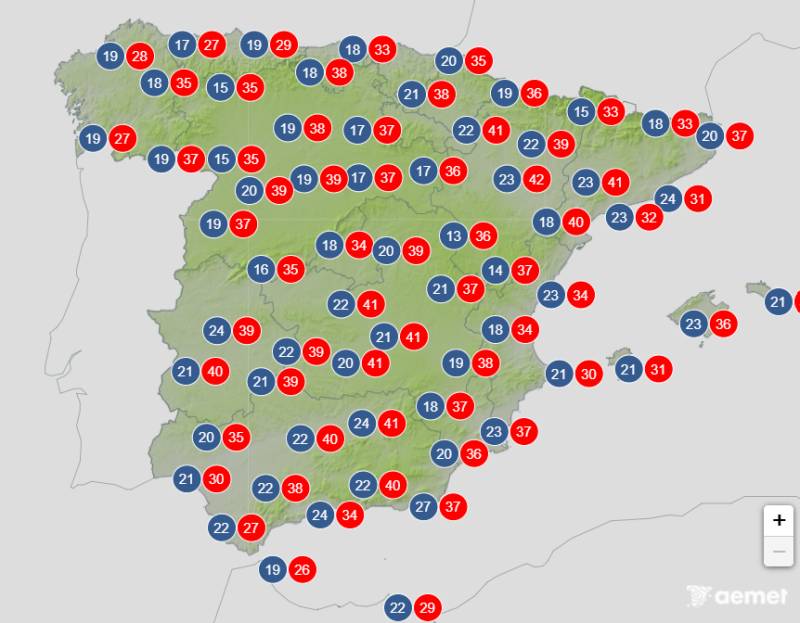
As for the weather, trends show that summer 2026 will bring higher than usual temperatures across much of the country.
The National Astronomical Observatory explained that the start of summer can fall anywhere between June 20 and June 22, though during the 21st century it will only occur on the 20th or 21st. These slight variations come down to the combination of the Earth's orbital period and how leap years are distributed in the calendar.
On Monday July 6, Earth will reach aphelion, the point in its orbit farthest from the Sun. At that moment, the two bodies will be separated by just over 152 million kilometres, about five million more than during perihelion, which happened on January 3.
Summer 2026 in the Northern Hemisphere is actually the longest season of the year because the Earth's orbit around the Sun is elliptical rather than circular. The summer period coincides with the time of year when Earth is farthest from the Sun, which means it moves more slowly in its orbit, according to Kepler's second law. Because of this slower pace, it needs more time to reach the point where autumn begins.
Although the summer solstice is the day with the most hours of sunlight, the exact difference between day and night depends on latitude. In Madrid, the solstice will bring 15 hours and 3 minutes of sunlight, compared to the 9 hours and 17 minutes recorded during the winter solstice. The gap between the longest and shortest day of the year therefore reaches almost six hours.
The summer of 2026 will also be packed with remarkable astronomical events. A total solar eclipse is expected on Wednesday August 12, and its total phase will be visible from the Arctic, Greenland, Iceland, the North Atlantic and parts of Spain shortly before sunset.
On Friday August 28, a partial lunar eclipse will be visible from Europe, Africa and the Americas. In Spain, the moon will set before the eclipse ends.
The traditional meteor showers will also put on a show. The Delta Aquariids will reach peak activity around Friday July 31, while the popular Perseids will do so around Thursday August 13.
Summer nights will offer plenty of chances to spot several planets and some of the most well-known star configurations in the sky. The Summer Triangle, formed by the bright stars Altair, Deneb and Vega, will be easy to pick out. The constellations of Scorpius and Sagittarius will also be visible, and their positions roughly mark the centre of the Milky Way. In areas with minimal light pollution, the galaxy can be seen crossing the sky from south to north in all its glory.
Full moons will fall on Monday June 29, Wednesday July 29 and Friday August 28.