






PROPERTY SEARCH

What caused the Córdoba train crash? These are the main hypotheses so far...
Investigators are focusing on possible infrastructure or mechanical failures as the cause of the accident
As Spain continues to mourn the victims of the deadly train crash near Adamuz, Córdoba on Sunday January 18, the question now becomes what caused the country’s worst rail disasters ever? The official investigation is expected to take weeks or even months to be completed, with authorities already warning that trains between Madrid and Andalucía may experience disruption at least until February 2 until they are able to clear and repair the affected stretch of track, but railway experts and engineers are beginning to outline the most likely explanations behind the tragedy.
The official death toll has now risen to 41 victims confirmed deceased, with rescue workers continuing to search through the wreckage for more bodies, both alive and dead.
So far, there are two main hypotheses for what caused the accident: (1) a failure in the railway infrastructure or (2) a mechanical problem affecting the train itself. Human error and excessive speed have been largely ruled out by both officials and independent specialists.
Renfe president Álvaro Fernández Heredia said on Monday that it was “highly unlikely” that driver error or speeding played any role in the accident.
“It has to have been some failure of the rolling stock or the infrastructure,” he said, pointing to the automatic safety systems that operate on the line.
Although the route uses the older LZB control system rather than the more modern ERTMS used on corridors such as Madrid to Barcelona, Fernández stressed that the system is fully operational and designed to prevent precisely this type of incident.
According to experts, even a perfectly functioning warning system would not have been able to stop the collision once the derailment occurred. César Franco, president of the General Council of Industrial Engineers, explained that the Alvia train passed the derailed Iryo train just 20 seconds later while travelling in the opposite direction.
“A train of that size moving at 200kmh needs at least a minute to brake,” he said. “In 20 seconds, it is completely impossible, even if an alert had been triggered immediately.”
Ramiro Aurín, a member of the Association of Civil Engineers, agrees. He says that in modern high-speed rail, excessive speed or human error are “almost entirely ruled out”.
“The safety systems monitor everything down to the millisecond,” he noted. “We know the trains were not travelling above the speed limit, and even if they tried to, the systems would have automatically braked them.”
The circumstances surrounding the crash
With those factors excluded, attention is now firmly on the track and the train’s mechanical components. The circumstances of the accident are particularly puzzling. As Transport Minister Óscar Puente has already pointed out, the derailment occurred on a straight section of track that was renovated in May, involving an Iryo train that had passed a technical inspection only days earlier.
Aurín highlights one key detail: the first five carriages passed through the area without incident.
“That might suggest the track was apparently fine, because otherwise the locomotive would have derailed first,” he said.
However, he also stressed that high-speed trains are subject to extremely strict controls, comparable to those in the aeronautical industry, with double safety systems throughout.
Investigators will now examine all the rolling stock in detail, paying particular attention to the points where the train interacts with the track, including bogies, suspension systems and wheels. Franco notes that even with a recent inspection, defects such as a slight misalignment or a microscopic crack in a wheel could go undetected.
Both experts also raise the possibility of a sudden failure in the infrastructure itself. Aurín suggests the track may have broken just as the sixth carriage passed.
“It could be a problem with that carriage’s bogies, or a crack in the manganese steel of the track that was not detected during inspections,” he said.
There have also been reports that several train drivers had previously heard unusual noises when passing through the same section. This could point to a micro-defect in the track that gradually weakened under repeated stress.
“Eventually the material fatigues and breaks,” Aurín explained. “When it breaks, it can cause a lateral movement that leads directly to a derailment.”
Another critical element under scrutiny is a switch point located where the accident occurred. Franco described switches as one of the most sensitive parts of railway infrastructure.
“The derailment happened right at that point,” he said. “Investigators will need to examine the condition of the needles very carefully to see if something became stuck during a change.”
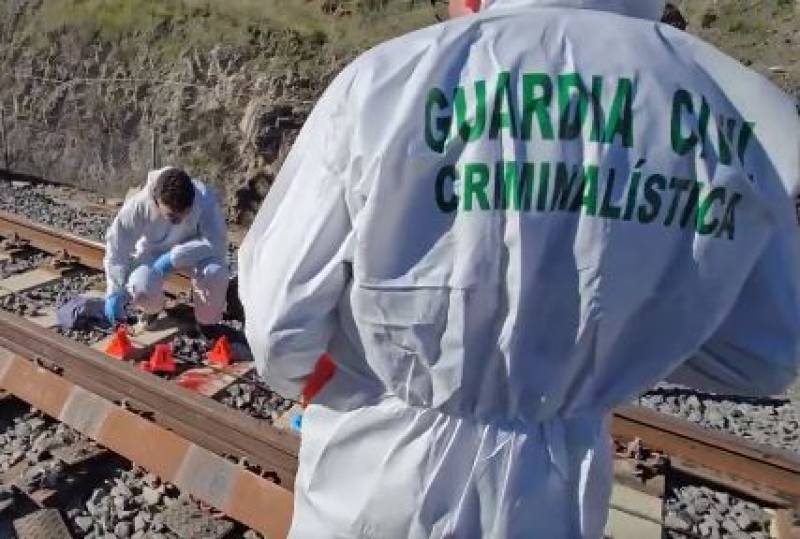
As forensic teams analyse data from the train’s onboard recorders and examine every component piece by piece, experts say the answers will come.
Image: Guardia Civil


Sign up for the Spanish News Today Editors Roundup Weekly Bulletin and get an email with all the week’s news straight to your inbox
Special offer: Subscribe now for 25% off (36.95 euros for 48 Bulletins)
OR
you can sign up to our FREE weekly roundup!
Read some of our recent bulletins:
Discount Special Offer subscription:
36.95€ for 48 Editor’s Weekly News Roundup bulletins!
Please CLICK THE BUTTON to subscribe.
(List price 3 months 12 Bulletins)
Read more stories from around Spain: