
















The Mar Menor continues to surprise scientists, with new research suggesting that most of the harmful nutrients entering the lagoon are coming from beneath the seabed rather than flowing in from the surface.
A study by the Institute of Environmental Science and Technology at the Autonomous University of Barcelona (UAB) found that between 70% and 90% of the nutrients reaching the lagoon come from underground water moving through the marine sediments below the seabed.
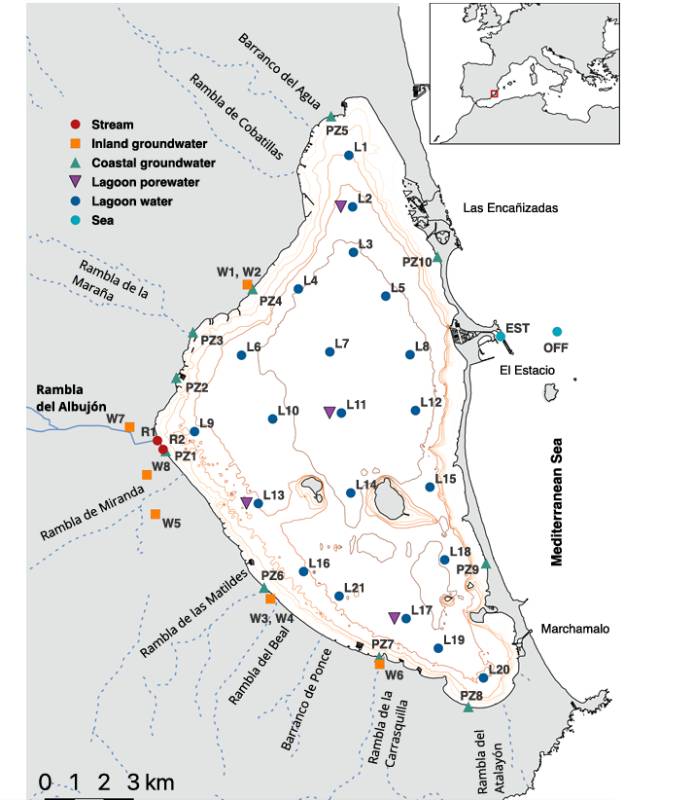
Published in the scientific journal Limnology and Oceanography, the research identifies these underground flows as the Mar Menor's main source of ammonium, organic nitrogen, inorganic phosphorus and silica, outweighing the nitrates carried into the Mar Menor by floodwater and run-off through channels such as the Rambla del Albujón.
 The researchers say their findings raise important questions about the way the Mar Menor is currently being restored.
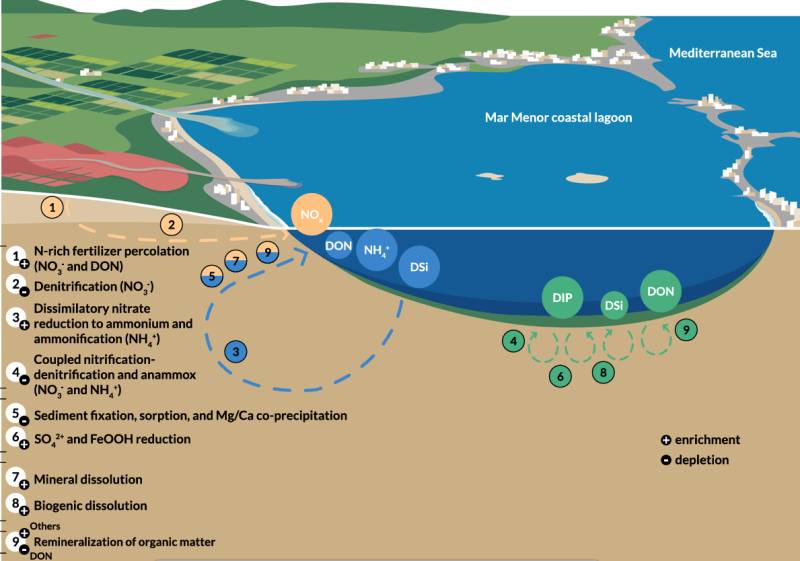
According to the study, water from the Mar Menor seeps down into the seabed, where it mixes with sediments that have absorbed pollutants from decades of farming and mining. The water then rises back into the lagoon carrying those nutrients with it. Scientists call this process Submarine Groundwater Discharge (SGD) and say it effectively recycles old pollution back into the water.
The research was carried out as part of the Opal project, funded by Spain's Ministry of Science, Innovation and Universities.
Scientists used naturally occurring radium isotopes to track how groundwater moves beneath the lagoon, allowing them to measure three different types of underground water flow.
The first involves freshwater from the Campo de Cartagena aquifer, which carries nitrates towards the coast. The other two involve seawater circulating through the seabed, one over long periods lasting months or even years, and another much faster process, known as porewater exchange, which takes place within the upper few centimetres of sediment over the course of just hours or days.
The researchers say the seabed is where many of the processes that affect water quality take place.
While low oxygen levels remove some of the nitrates arriving from inland through a natural process known as denitrification, the sediments also release large amounts of ammonium and dissolved phosphorus back into the lagoon.
According to the study, more than 80% of the lagoon's ammonium and over 98% of its dissolved inorganic phosphorus come from this underground recycling process.
 The findings differ from comments made recently by Laura Martín, Spain's Commissioner for the Water Cycle and Ecosystem Restoration, who said the aquifer is not the Mar Menor's biggest threat.
Instead, she argued that the greatest damage is caused by heavy rainfall, which washes large amounts of sediment and pollutants into the lagoon during flood events.
However, the UAB researchers believe their work helps explain why the Mar Menor continues to suffer episodes of eutrophication, where excess nutrients trigger rapid algae growth, even when more visible sources of pollution are being tackled.
They also found that the problem changes with the seasons.
During winter and spring, the lagoon contains plenty of nitrogen but relatively little phosphorus, limiting algae growth. In summer, however, higher temperatures and stronger winds dramatically increase the amount of phosphorus released from the seabed.
The study found phosphorus levels rise by around 400% during the warmer months, removing this natural limit and allowing phytoplankton blooms to develop more easily.
The scientists say their findings have important implications for the future management of the Mar Menor.
They argue that Spain's Priority Action Framework for the Restoration of the Mar Menor includes a range of measures to restore the lagoon and its surrounding environment, but does not specifically address nutrients entering through groundwater moving beneath the seabed.
According to the researchers, recognising this hidden pollution pathway will be essential if restoration efforts are to become more effective.
The Ministry for Ecological Transition (Miteco), however, disputes the study's conclusions.
Officials say the research mainly focuses on sediments that have accumulated on the lagoon floor after years of torrential rain washing contaminated material into the Mar Menor.
They also reject suggestions that groundwater has been overlooked, pointing out that several research teams are already investigating both the lagoon's sediments and the surrounding aquifer using data collected from monitoring boreholes.
The ministry says the combined results of these studies will improve understanding of how the Mar Menor functions and help guide future decisions.
Commenting on the study, Ángel Pérez Ruzafa, president of the Mar Menor Scientific Committee, said it "confirms everything we have been saying".
Pérez Ruzafa said the study's findings are consistent with years of monitoring data and the recent history of the Mar Menor, adding that this strengthens both their scientific credibility and their importance.
While the study identifies underground flows as the main route by which harmful nutrients are now entering the Mar Menor, the researchers stress that the pollution itself is largely the legacy of decades of intensive agriculture, with historic mining activity also playing a role. Their findings suggest the problem is no longer just about stopping new pollution from entering the Mar Menor, but also about tackling the vast amounts of nutrients already stored beneath the lagoon, where they continue to be released back into the water.
Read also: Murcia's Portmán Bay and Mar Menor handed black flags over pollution and mismanagement
Image 1: Archive
Images 2-3: LIMNOLOGY and OCEANOGRAPHY